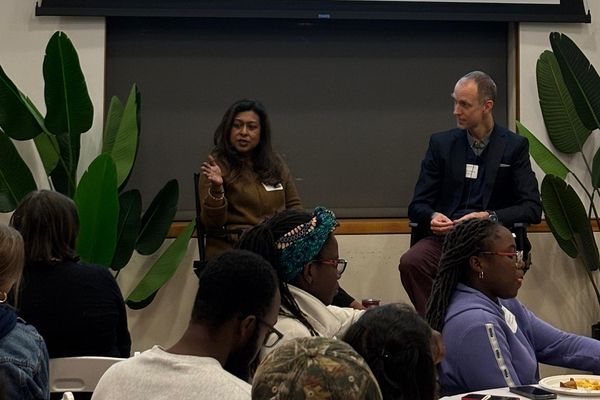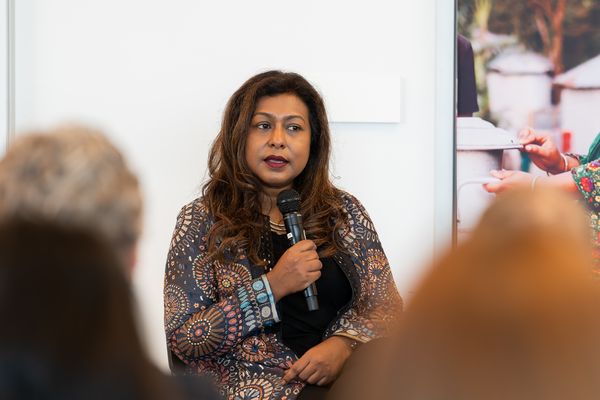
On November 20, BRAC, Vital Impact, and Santa Clara University’s Miller Center for Global Impact co-hosted a luncheon focused on women leading social change amid this watershed moment in international development and philanthropy. The event featured a fireside chat between Tamara Hasan Abed, Managing Director of BRAC Enterprises, and Rena Greifinger, Managing Partner of Maverick Collective. Together, they explored how purpose-driven business, community leadership, and bold ideas can work together to transform lives.
Building from community potential
Tamara opened with the story of BRAC’s start more than a half century ago, following Bangladesh’s Liberation War in 1972. “We started with emergency relief,” she said, “but soon it became clear that people needed longer-term development…especially income and livelihoods.”
“So BRAC went ahead and innovated and used all the potential assets and the potential of people in the community to be able to transform their own lives,” Tamara shared. “And we came up with these solutions working very closely with the community.
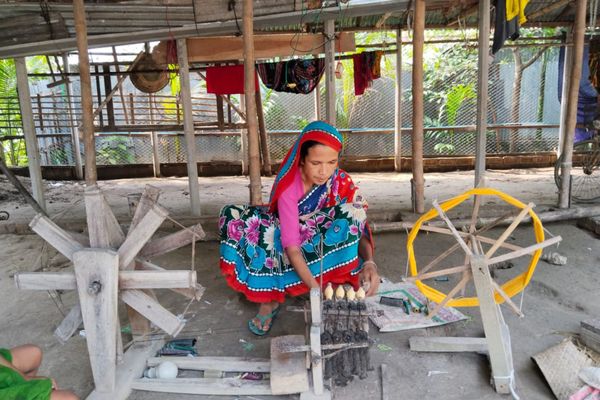
From village development projects came a series of community-led enterprises. Tamara described how BRAC tapped into existing resources in rural communities, such as ponds, farmland, livestock, and women’s own embroidery skills, to build sustainable income opportunities for people in Bangladesh’s hardest-to-reach communities.
Aarong, in particular, grew directly from those early efforts, and now connects nearly 87,000 artisans to markets annually. “Aarong now has annual revenue of about $150 million, and we invest 50% of our surplus into BRAC’s development work,” Tamara said.
“This has been the ethos of BRAC: constantly thinking and innovating about how to create sustainable livelihoods for people in rural areas.”
So BRAC went ahead and innovated and used all the potential assets and the potential of people in the community to be able to transform their own lives. And we came up with these solutions working very closely with the community... This has been the ethos of BRAC: constantly thinking and innovating about how to create sustainable livelihoods for people in rural areas.”
Tamara Hasan Abed
Managing Director, BRAC Enterprises
When purpose strengthens profit
The conversation turned to the tension between impact and financial sustainability. Tamara was quick to challenge any assumption that the two can’t coexist.
“It’s very important to be sustainable,” she said. “Development programs can have interventions designed for a few years, but the thing about social enterprises is that they’re far more sustainable and can carry livelihoods over a person’s life.”
She pointed to BRAC Dairy as an example of how financial success can power financial inclusion. Profitable milk centers in wealthier regions helped subsidize new ones in poorer areas, especially as new BRAC chilling centers could take years to become viable.
“Financial viability is very important,” Tamara noted. “But the whole purpose of a social enterprise is to solve a social problem.”

Financing systems change
Rena asked about the role of philanthropy and investment in driving systemic change. “When you think about the ways in which systemic social change gets financed, there’s, I believe, always a way for philanthropy,” she said. “There’s a role for impact investing. There’s a role for blended finance.” Tamara stressed that social enterprises need “patient capital” that supports innovation where private investors hesitate.
Impact investing must go where private investment doesn’t, she stressed. “If investment goes only where private capital already flows, that’s not the role of impact investing.”
She cited BKash, Bangladesh’s leading mobile financial platform, as an example of blended finance in action—combining grants and equity from partners like the Gates Foundation and IFC to scale financial inclusion.
“A lot more needs to be done in terms of how to encourage more financing options for social enterprises, because as we all know, there are intractable problems in the world right now that will need investment in social enterprises. Development funding is decreasing, and so we need to solve some of these problems through enterprises.”
Financial viability is very important. But the whole purpose of a social enterprise is to solve a social problem... If investment goes only where private capital already flows, that’s not the role of impact investing.”
Tamara Hasan Abed
Managing Director, BRAC Enterprises
A future full of opportunity
Looking ahead, Tamara sees growth in areas that create both jobs and resilience: “Health, education, climate adaptation, agriculture, skills, and green employment—all are ripe for social enterprise innovation,” she said.
Her optimism was matched by a sense of duty. “In the Global South, there are all these economies with large, young populations and the need for jobs. There’s a lot that can be done.”
Rena ended by asking what keeps Tamara at BRAC after a career that has spanned banking, entrepreneurship, and global business. “I fell into BRAC by chance, believe it or not,” Tamara said. After working at Goldman Sachs and a period of reflection following September 11, she returned to Bangladesh in the early 2000s.
“Once I started working with Aarong, I felt I had found my calling. I found my passion. I can’t tell you how satisfying and interesting the work is. It’s really exciting. You see change in people’s lives. You work across many sectors. You see people moving forward.”
The exchange closed with a shared belief in collaboration and courage. A reminder that when purpose guides enterprise, change becomes not just possible, but inevitable.
Meeting the Moment progressed into a panel discussion, featuring Brigit Helms, the Executive Director of the Miller Center for Global Impact, Alison Fahey, Global Director of Partnerships and Strategic Initiatives at J-PAL, and Leslie White, the President and Co-Founder of the Pace Able Foundation.