In coastal Bangladesh, where saltwater intrusion steadily poisons farmland and pushes families deeper into poverty, the connection between climate change and livelihoods is not abstract: It is felt in every failed harvest.
For Archana Sardar, a mother of three from Assasuni, Satkhira, that connection was becoming a trap. Then she found hope in vermicomposting. By converting cow manure into organic fertilizer, she is rejuvenating her salt-damaged soil, cutting emissions, and building a sustainable future for her family, one handful at a time.
“There were days when even an additional BDT 2,000 ($17) felt out of reach. My daughter would ask for a small thing—a book, or a new dress—and we had to tell her to wait, maybe next month. Now, from the income I earn, I can buy her those little things. Giving my children these small joys—that is my biggest win.”
The struggles of farming in a changing climate
Globally, agriculture remains one of the most climate-sensitive livelihoods. Salination of freshwater and soil impacts around 500 million people worldwide. In the south-west coastal region of Bangladesh, the exposure is magnified as saltwater intrusion jeopardizes agricultural productivity.
In a country where 45% of the population relies on agriculture, not only for food but also for income, rising salinity is making farming increasingly uncertain.
Many like Archana’s family have long sustained their livelihood through farming, but deteriorating soil fertility, coupled with cyclones and erratic rainfall, made traditional practices harder, leading her to explore new adaptation methods.
Read more: Fighting the white curse: growing crops in salty soil
A small business grown at home
Archana's turning point came when she was introduced to vermicomposting by BRAC’s Climate Change Program. Vermicompost is a nutrient-rich organic fertilizer created with the help of earthworms.
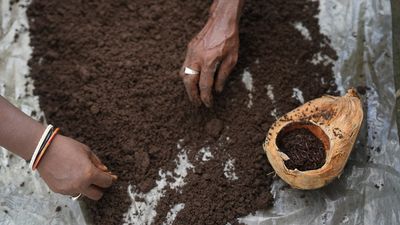
Every morning, Archana collects the manure from her two cows into a semi-enclosed storage pit. She gathers approximately 30 kilograms of manure per day. After slightly drying out the fresh manure, she adds it to her two composting pits along with a handful of earthworms. The earthworms break down and consume the organic matter, and their castings become high-quality, organic compost, rich in beneficial microbes and nutrients.
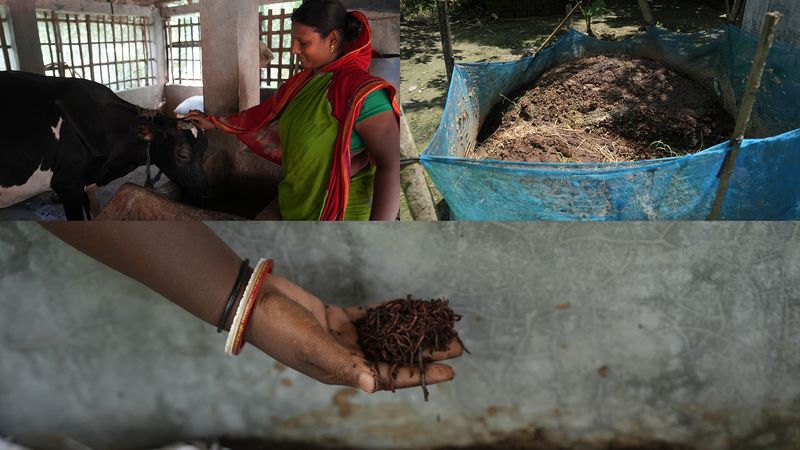
From left to right: Archana with her cow, semi-enclosed storage pit, and worms being added to the manure. © Anima Ashraf/BRAC 2026
Every 60 days, Archana harvests 200 kg of vermicompost from each pit. She and her husband use half of the compost on their own land for rice cultivation and vegetable farming, and Archana sells the rest. Selling the compost for BDT 20 ($0.16) per kilogram, Archana generates an annual income of around BDT 24,000 ($197) from the compost alone.
Read More: Turning waste into wealth for women in coastal Bangladesh
Before starting this venture, Archana used to sell some of the raw manure to her neighbors and turn the rest into firewood for cooking. However, much of the manure was left in an open pit, unused and ultimately wasted.
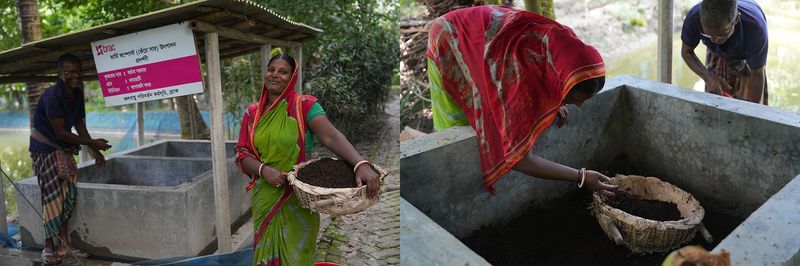
From left to right: Archana and her husband in front of the composting pits, Archana collecting ready compost. © Anima Ashraf/BRAC 2026
BRAC’s input support and hands-on training in vermicomposting opened up a new income stream for Archana, enabling her to transition from simply being a farmer to becoming a small-scale business owner. For someone who had seen her land struggle year after year, this felt like a glimmer of hope, a chance to restore what had been slipping away.
“All the compost I produce is sold before it's even ready. My production is still small, but I hope to expand, especially now that other women in my neighborhood are eager to learn the process from me.”
Despite its promise, scaling vermicomposting is limited by a lack of materials, space, technical support, and, for rural women, insufficient capital, time, and market access.
BRAC’s ecosystem addresses these barriers simultaneously by combining training, input support, community networks and market linkages, enabling vermicomposting to move from a niche local practice to a scalable, adaptive livelihood solution.
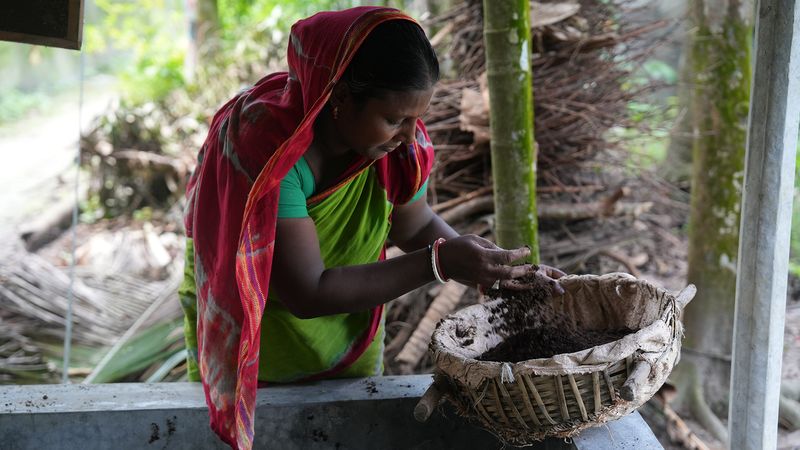
Every two months, Archana harvests 200 kilograms of vermicompost from each pit, generating an annual income of around BDT 24,000 ($197). © BRAC 2026
Reviving soil, reducing emissions
Archana's husband farms half an acre of land. Before adopting climate-resilient practices and organic compost, a third of an acre of land yielded just around 160 kilograms of rice. Now, with vermicompost and resilient seeds, it produces approximately 1000 kilograms.
Vegetables, once impossible to grow in saline soil, now earn the family BDT 60,000 annually ($494). The quality and yield of both vegetables and rice have improved, and the once-damaged soil is now healthier and more resilient.
Vermicompost also helps reduce topsoil erosion by improving soil structure and water retention, preventing runoff. It also lowers salinity by displacing toxic sodium, increasing beneficial calcium and potassium, and supporting a healthier microbial community, making the soil more fertile and resilient.
“The plants grow faster, stronger, and are less prone to diseases. Even after repeated harvests, the soil has held its strength. I believe vermicompost has stopped our rice fields from losing their fertility,” Archana shares proudly.
Beyond creating an additional income for Archana, the use of vermicompost as the main fertilizer has cut the family’s annual fertilizer costs in half, from BDT 6000 ($50) to BDT 3000 ($25).
Archana’s efforts extend beyond just adapting to climate change. She is also contributing to mitigating climate change. Today, her method prevents approximately 0.27 tons of carbon dioxide (CO₂) equivalent emissions annually.
Across the country, 172 participants in BRAC’s Climate Change Program are practicing vermicomposting, collectively avoiding approximately 83 tons of CO₂ equivalent emissions each year.
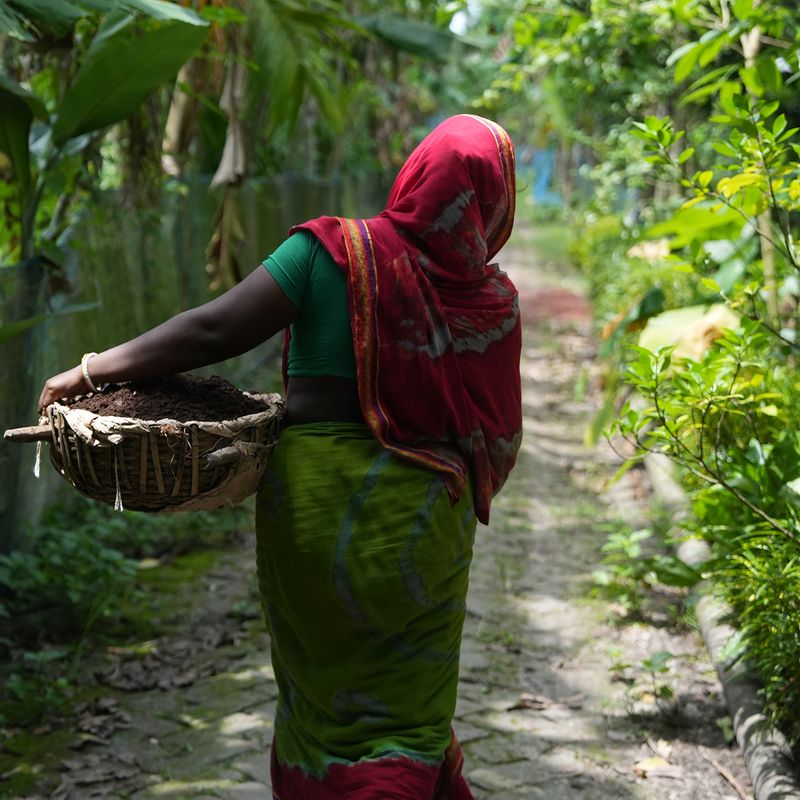
Archana’s story resonates with that of thousands of women in coastal Bangladesh. © Anima Ashraf/ BRAC 2026
Livestock is a big deal not just for food, but for the climate. Globally, it produces 14.5% of human-made greenhouse gases. In Bangladesh, by 2035, livestock could contribute over 50 million tons of carbon dioxide equivalent as per Bangladesh’s updated Nationally Determined Contribution (NDC), making it one of the largest sources of emissions. Sustainable farming isn’t just smart, it’s essential.
The 83 tons from some of BRAC’s participants may seem modest on a national scale, but for communities living on the frontline of climate impacts, even locally-driven, small-scale mitigation initiatives can add up to meaningful climate resilience.
The challenge ahead
Bangladesh aims to reduce 4.81 million tons of CO₂ eqivalent emissions by 2035, and the NDC has also identified vermicomposting as a key solution for cutting emissions. This places the work of women like Archana not only at the heart of local resilience, but also within Bangladesh’s commitment to global climate action.
However, the challenge is twofold: Bangladesh must bridge its climate mitigation gap under the NDC, while safeguarding the climate-sensitive coastal livelihoods that millions rely on for survival.
Archana’s story is a triple-win story. It showcases how one solution simultaneously improves soil health on highly saline land, locks carbon back into the soil to reduce greenhouse gas emissions, and creates an income source that empowers thousands of women.
Anima Ashraf is the Specialist, GHG Emissions Accounting and Reporting, Climate Change Program, and Kamran Ibne Abdul Qader is the Senior Specialist, Knowledge Management and Communications, Climate Change Program.