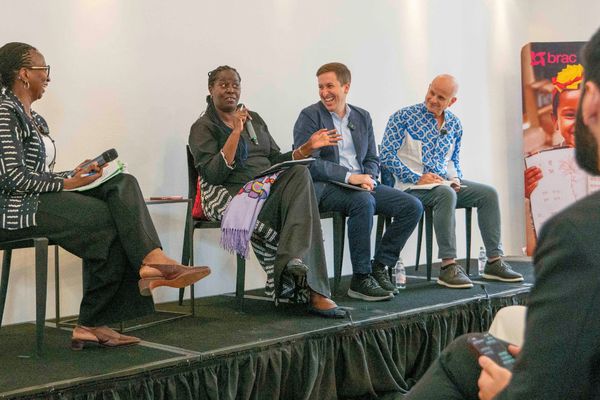
NEW YORK, NY — What does institutional transparency look like when organizations are willing to talk not only about what worked, but what didn’t? BRAC, one of the world’s largest development organizations, has released its 2026 Failure Report, examining programs and initiatives that fell short of their goals, the decisions and assumptions that contributed to those outcomes, and what BRAC learned as a result.
Now in its sixth edition, the Failure Report reflects a practice that has long been part of BRAC’s approach to development: treating failure not as something to hide, but as an opportunity to question assumptions, adapt programs and ultimately identify solutions that not only work, but can work at scale. That philosophy traces back to BRAC’s founder, Sir Fazle Hasan Abed, who encouraged staff not to see failure as a bad thing, but as an opportunity to learn and improve the services BRAC provides.
“By sharing our failures and the lessons they have taught us, we hope to contribute to a culture where organisations across the sector can be more open about what did not work, learn faster, and ultimately design better solutions for the communities we serve,” said Samin Nower Kashmy, Head of Innovation for BRAC’s Social Innovation Lab.
The 2026 report examines four failures and a recap across BRAC’s work:
1. A digital health system that created more work, not less
BRAC introduced a digital data system intended to reduce paperwork for frontline health workers in Bangladesh. Instead, the system grew to require the collection of more than 400 data points per visit, creating a new administrative burden. BRAC eventually scaled back and redesigned the system around frontline workflows, improving data quality and service delivery while reinforcing a simple lesson: technology must be built around the people expected to use it.
2. A “proven” youth program that failed and recovered
Launched in Uganda in 2006, BRAC’s Empowerment and Livelihoods for Adolescents (ELA) program had demonstrated significant early impact and expanded across several African countries. But a 2019 internal study found that more than half of a sample of supposedly active clubs effectively did not exist. BRAC concluded that it had relied too heavily on early evidence of success while failing to sufficiently refresh, contextualize and monitor the model as it scaled. Lessons from the subsequent redesign now inform a program aiming to reach 2 million adolescent girls and young women across seven African countries by 2033.
3. An innovative manufacturing model that couldn’t scale
During the COVID-19 pandemic, BRAC developed a distributed manufacturing network using local fabrication labs and makerspaces to produce urgently needed goods. While the initiative successfully produced more than 3,300 items for over 4,000 frontline workers, regulatory and institutional barriers prevented it from becoming a sustainable long-term model. The experience underscored the importance of testing whether the broader ecosystem is ready to support an innovation before attempting to scale it.
4. An ambitious safe water project that failed to find market fit
BRAC’s Safe Water for All project set out to establish 21 water treatment plants and 9 effluent treatment plants in Bangladesh. Instead, the project closed six months early with no effluent treatment plants established and only two water treatment plants, both ultimately remaining in BRAC’s ownership. BRAC points to overambitious targets, insufficient attention to local knowledge and infrastructure, and a failure to find market fit among the lessons from what the report candidly describes as a “full fledged failure.”
The report also revisits Shohochor, an employee transportation initiative first featured in BRAC’s 2018 Failure Report after it could not be scaled using BRAC’s largely paper-based systems. Years later, after the organization digitized its transport infrastructure, BRAC returned to the idea. The service launched in 2023 and now facilitates an average of 700 seat exchanges each month.
Together, these examples illustrate a larger principle behind the report: failure does not necessarily mean an idea is wrong or that the work ends. It can reveal flawed assumptions, expose gaps in systems or show that the conditions needed for success are not yet in place. For BRAC, understanding why a solution fails, particularly as it grows, is part of understanding what it takes to build solutions that can deliver lasting impact at scale. By publicly sharing where it has fallen short, BRAC hopes to encourage greater transparency across the development sector and a culture where learning from what doesn’t work is as essential as measuring what does.
Notes to the editor
About BRAC
BRAC is an international development organization founded in Bangladesh in 1972 that has partnered with over 145 million people living with inequality and poverty to create opportunities to realize human potential. BRAC works with communities in marginalized situations, hard-to-reach areas and post-disaster settings across Asia and Africa, with a particular focus on women and children. Born in and led from the global south, BRAC operates as a solutions ecosystem, including social development programs, social enterprises, humanitarian response, a bank and a university.
About BRAC USA
Based in New York City, BRAC USA is an independent 501(c)3 organization that strengthens BRAC’s impact by raising awareness and mobilizing resources to support and amplify its programs for the people we serve. Learn more at bracusa.org.
Media Contacts
Interdependence
Emma Green
BRAC@interdependence.com