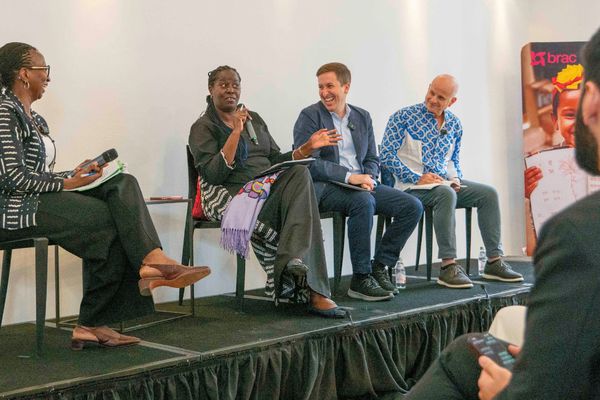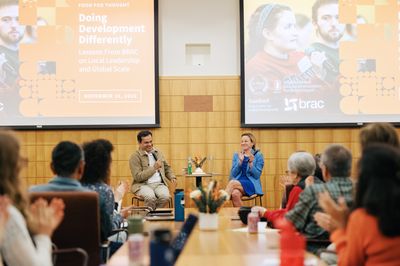
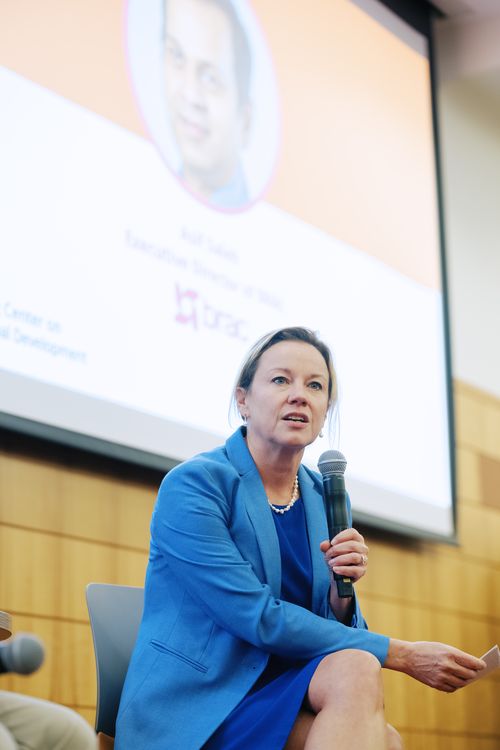
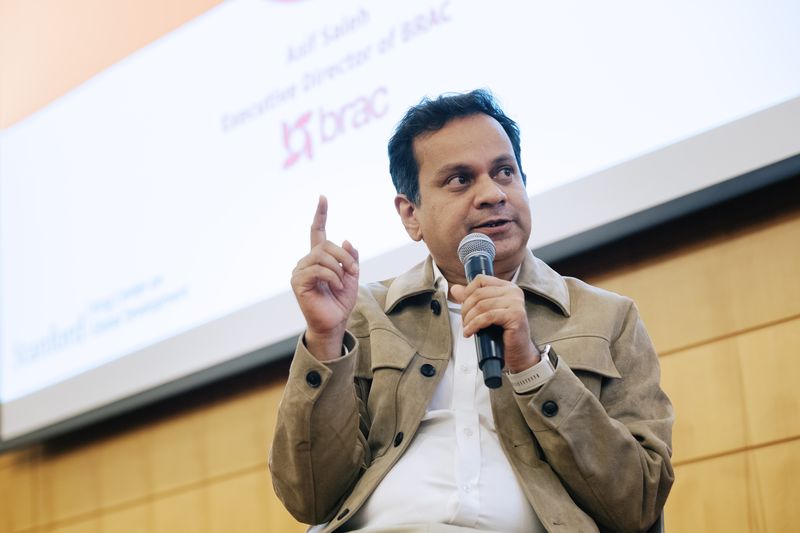
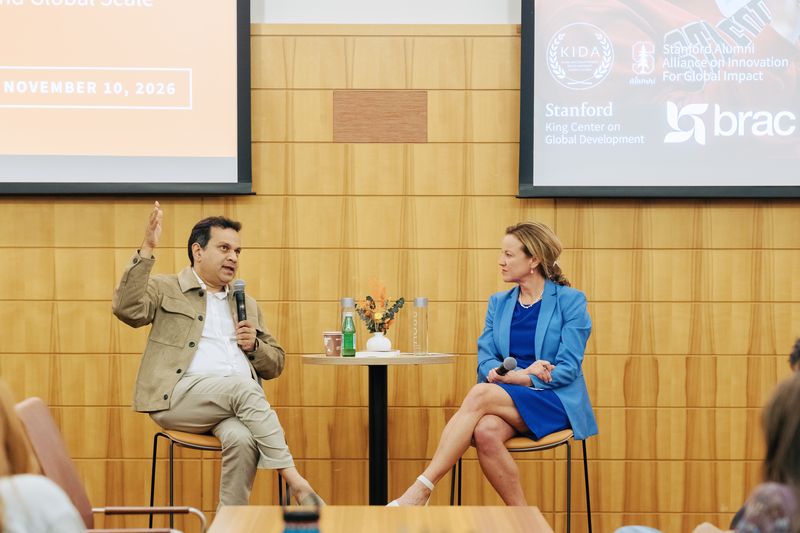
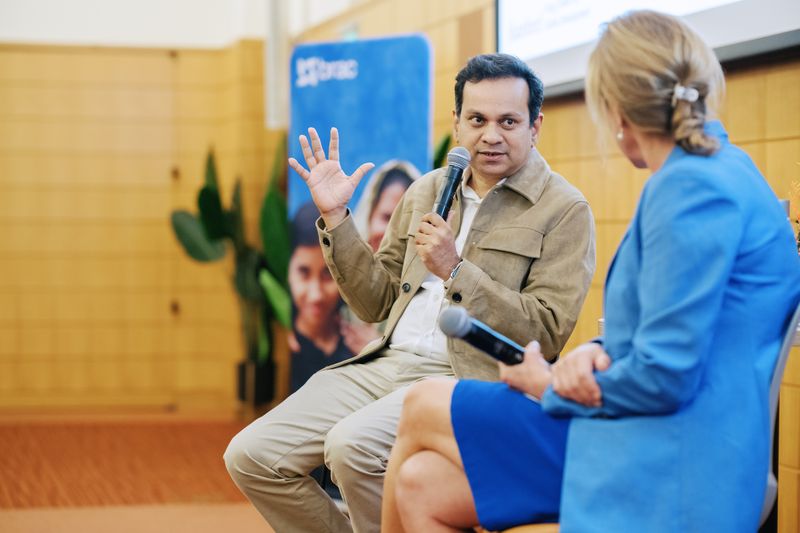
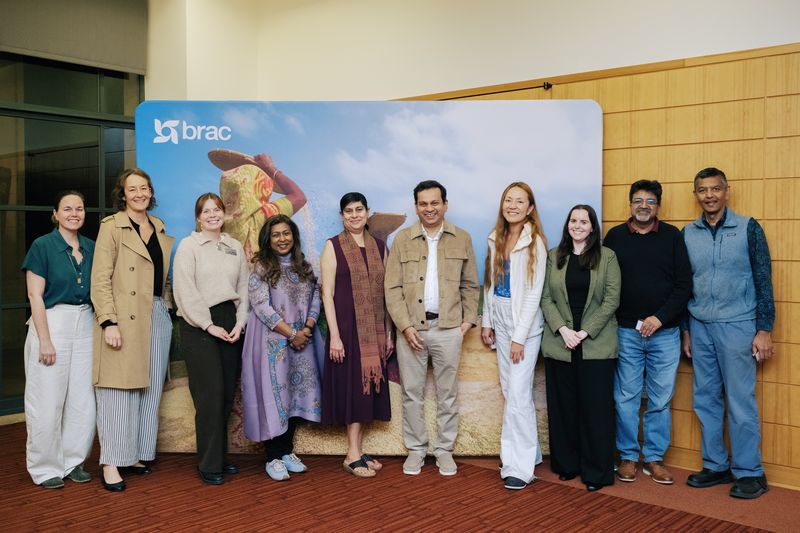
On November 10, Asif Saleh, Executive Director of BRAC, sat down with Katherine Casey, Faculty Director at Stanford University’s King Center on Global Development for a candid conversation. Part of the King Center’s event series, their discussion focused on locally-led solutions, stronger systems, and the future of development in a changing aid landscape. Following are highlights from their conversation.
“Small is beautiful, but large is necessary”
Kate Casey: BRAC has been a leading voice in fighting poverty for more than 50 years. Can you bring us all onto the same page about your guiding principles and what you’re trying to accomplish?
Asif Saleh: Essentially, the fundamental thing about BRAC is it started very small. Our founder came back to Bangladesh from London to support refugees returning from India after the Liberation War. Months later, we realized relief alone wasn’t enough. Every issue is actually connected. When you try to solve one problem, you see that it is connected to other issues.
So BRAC needs to be an organization that always solves social challenges. As social challenges change over time, BRAC needs to evolve as well.
What hasn’t changed is our belief that every individual has potential. Many people can’t realize it because they lack access to services like education, finance, or healthcare, because of their gender or the social class they belong to. Our goal is to give people the tools so that they themselves can change their lives. That’s very different from traditional charity, where people are passive recipients. People are active participants in the change process.
Sir Fazle used to say that women are the best managers of poverty. They should be the managers of development as well. For a country like Bangladesh, it was a quiet revolution when women community health workers started coming into communities to deliver services.
We’re also agnostic about what approach we take. We want to find the best solution, and that includes building enterprises that support revenue generation.
As our founder used to say, small is beautiful, but big is necessary. Doing something small that makes a great story isn’t good enough. Doing something at scale is what we need for impact.
Learning what works, then scaling it
Kate Casey: The Ultra-Poor Graduation program is something BRAC pioneered, and it was refined through randomized controlled trials with researchers in many countries. How did it become what it is today, and reach the scale it has?
Asif Saleh: It’s not just RCTs. Research has always been central to BRAC. We built our first research department in 1975, when it was unheard of for an organization like ours. You start with an assumption, test what’s working and what isn’t, and stay agile enough to pivot. We’re a learning organization.
When we talk about getting a model ready for scale, it means asking: what are the most essential elements of that model that can make 80% of the impact? We have to keep the most important elements.
Graduation has been such an interesting journey. Back in the late 1990s, we started to see that across the board, roughly 15 to 20% of our microfinance borrowers in Bangladesh were not able to pay, or not getting the benefit of microfinance. These were the ultra-poor, the most vulnerable. They were typically women who, oftentime, got married at 12 or 13, by the time they’re 20, they’ve been left behind by their husbands or widowed with four children, with absolutely no asset base, and maybe working in other people’s homes. Loans were not useful for them.
So we designed a two-year model. It starts with an asset transfer. Then a program officer visits the household—it’s a very household-based program. There’s screening, there’s coaching. Every week there’s a visit. We track nine indicators, from how many sources of income they have to sanitation, savings, children’s schooling, and access to healthcare. And then the work happens over two years, and if participants have met those indicators, we say they have now graduated. They have started earning, they have some asset base. This is the technical part.
But the non-technical part is the most important part - it’s the softer part. Somebody who is so invisible in society that nobody thinks about them. Suddenly, they have a program officer coming to their house, giving them an asset, and telling them, “you matter,” and “you can do it.” It’s like a light bulb switching on. Once that gets switched on, there’s no turning back. It’s like a ladder, and they can climb the ladder on their own. So it’s that bit which is the most important part, rather than the asset transfer, and everything else.
So that model really worked. And then we scaled up in Bangladesh. We have now graduated more than 2.4 million families, so if you say there are five members of a family, then it’s more than 12 million people that have graduated out of this program, just in Bangladesh alone. In 2006, we said if it works in Bangladesh, it could work in other places. We then tested it in six other countries, with an RCT started (by Esther Duflo). And when the results came out in 2015, and said it worked in all of these countries, and interest exploded. Since then, we’ve been scaling Graduation through governments. The largest, government-led Graduation program is happening in India. Through this, we see $1 in philanthropic money has leveraged almost $50 in public resources.
For the future of BRAC, one of our big goals for us, is to say, this is a model we know that works. So how can all of us take this, and scale it up.
Sixteen agencies, one household
Kate Casey: We’re in a highly constrained time for global development. In your blog on ‘Ten shifts that could save development cooperation,’ the first is to stop funding so many intermediaries. What do you mean, and who sets the agenda instead?
Asif Saleh: Let me share a personal experience. In 2017, the Rohingya refugee crisis began in Cox’s Bazar. We at BRAC were more of a player in the development field, but not in humanitarian settings. We’ve now been in operation there for nine years, and we have to work with a large number of intermediaries.
I was speaking to one of the refugee families there. I asked, “how many members of different agencies come to your household each week?” She said it was 16. One for health, one for education, and so on. Not only are there a number of camps. Within each camp, there are sector divides. Then each sector lead allocates the work to different NGOs. Do we need so many agencies? After nine years, this is not a humanitarian crisis. It’s a protracted development crisis.
When the US government cuts came, the first thing cut was rations, rather than the agencies themselves. It’s the local organizations who are actually doing the work. But by the time the money that was initially granted comes to local organizations, every layer has taken its share.
Then they say local organizations don’t have the capacity. What capacity are you talking about? They say, they can’t do grant management. But we don’t fund their overhead - maybe 2% - so they can’t build that capacity. It’s a chicken and egg situation. A vicious cycle going on. In this age and era, when we’re talking about how to do more with less, this is absolutely insane. If we’re actually committed to getting services to the people who need it most, then we have to make the most of the money that’s coming in. What are we doing about really localizing the response? How are we building capacities on the ground? And who actually defines those capacities?
So we said to funders: if you are funding us, because you think we are less risky than a small local organization, why don’t you give us the money, and we are going to channel the money to the local organizations, and at the same time help them build capacity in three-to-four years. That has started to work really well. We started with a few, and have now 25 organizations that we have supported. And now, 17 you can fund them directly. That’s the idea behind our pooled fund for localization.
Fund the outcome, not the how
Kate Casey: There’s a lot of talk about a third wave of philanthropy, driven by new wealth. How are they going to spend their money? There’s a side conversation happening, too: is there capacity to absorb that money? Others say there is, if we fund more focused and efficient routes. What do you say?
Asif Saleh: Capacity is really about compliance, not about impact. In international development, “capacity” often just means who can manage the funder’s money. You have armies of people chasing paper from one place to another, ensuring compliance, as opposed to the actual work that is happening.
The focus should be on what’s already working. Find the models with evidence behind them and scale them, whoever runs them. BRAC’s models are open source. Anyone can run Graduation, and we provide technical support to many organizations that do.
We also need to get into this idea of trust-based philanthropy. You don’t focus so much as a funder on the “how” part. You leave the how to the people who are closest to the problems to design the how. And you focus on the outcome. Once you have a more trust-based philanthropy, you have a more trusting partnership, and a vision for the long haul. If funding moves from one project to the next every few years, nothing sustains. The LEGO Foundation, for example, has said: we’re going to be on this journey with you for 20 years. That’s really important.
As for the third-wave philanthropists, I see a trend where they’re starting to collaborate more, being more focused on evidence, trying to get into the nuances, and they are very focused on scale. That’s encouraging.
Patient capital goes where private capital won’t
Audience member: The links between BRAC’s social enterprises and the rest of BRAC seem key to its success. What can the impact investing community, which often works in silos, learn from that?
Asif Saleh: Our social enterprises were set up as part of our programs. Each was created because of a challenge we saw in a program. The “social” part matters. You want to set it up because private capital is not flowing there. If capital is already flowing into a sector, impact money isn’t needed there.
If you keep at it and focus on scale, those efforts can grow into profitable businesses. But you must be patient for returns. It may take 15 or 20 years.
In order for a sector to be developed, you have to do a lot of investment in the ecosystem. When we started our first poultry business in Bangladesh, for rural livelihood diversification, we needed feed mills and an army of trained vaccinators. In livestock, we brought in artificial insemination from abroad, and then created a core group of people who were trained to provide it as a service.
If we want to truly solve a problem for the poor, honesty and authenticity are needed in how we pursue impact as a whole. Not every problem has a business model. For example, the work we’re doing with the ultra-poor, such as Graduation, healthcare, and education will always need funding. It’s important to identify your target group, and how you define impact.
Earning a donor’s trust
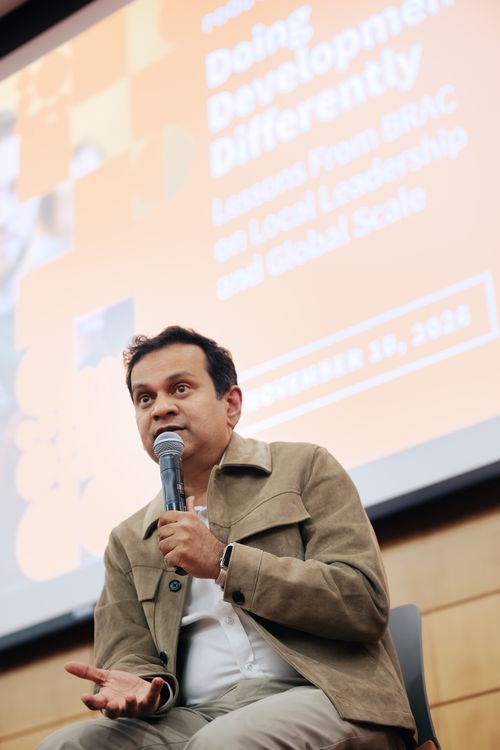
Audience member: I love the idea of trust-based philanthropy, but some donors ask: why would I trust an organization to do a good job? How do I make sure what I’m giving is not being used for something I didn’t approve? How would you communicate that idea of trust to funders?
Asif Saleh: That’s a genuine question. How do you trust an organization if you don’t know the organization? That’s where your data, reputation, and past experience come in. Part of it is that you look at the track record, and you look at the evidence. When you pay for a $500 bag, you’re probably trusting the brand.
Trust-based philanthropy doesn’t mean you write a check and you forget about it. It means you focus less on the “how” part, you focus on the outcome. If you’re focused on pleasing the donor, but you see something isn’t working on the ground, you don’t have that transparency and trust to talk to that donor to say ‘what you’re suggesting isn’t working.’ MacKenzie Scott has changed the way philanthropy is done. Our Ultra-Poor Graduation Initiative was made possible by people like her. They check in with us and see what we’re doing - in terms of where our focus is, what we’re doing.
For smaller donors, I think it’s important that you tackle a big issue and coalesce around others. Whether it’s one country or one issue, like ending extreme poverty or gender equality, you have that stronger impact by focusing on a few things.
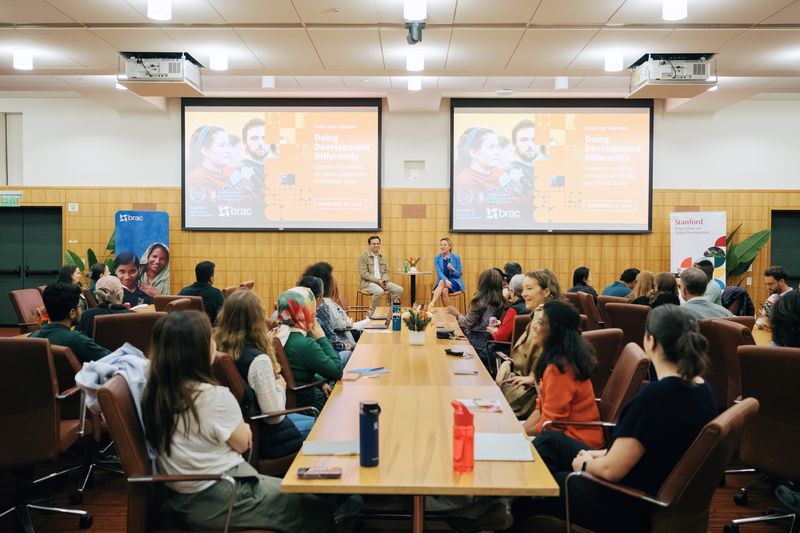
“People have forgotten”
Audience member: The situation in the Rohingya camps is so tragic and appears to be deteriorating. How do you think we can turn this around, and improve things for people who are so marginalized?
Asif Saleh: It has become very complicated, especially with the geopolitical challenges happening now.
And this is an area facing other problems, like drug trafficking and human trafficking. This is what worries me - there’s a huge number of young people who do not see a future. And they see what they’re missing out on.
Particularly after the pandemic, Ukraine, the Gulf War - people have forgotten. In this era of social media, the news cycle lasts three days. Right now, we’re ensuring basic services, and we’re lobbying the government to let us give people basic skills, so they can find livelihood opportunities wherever they are.
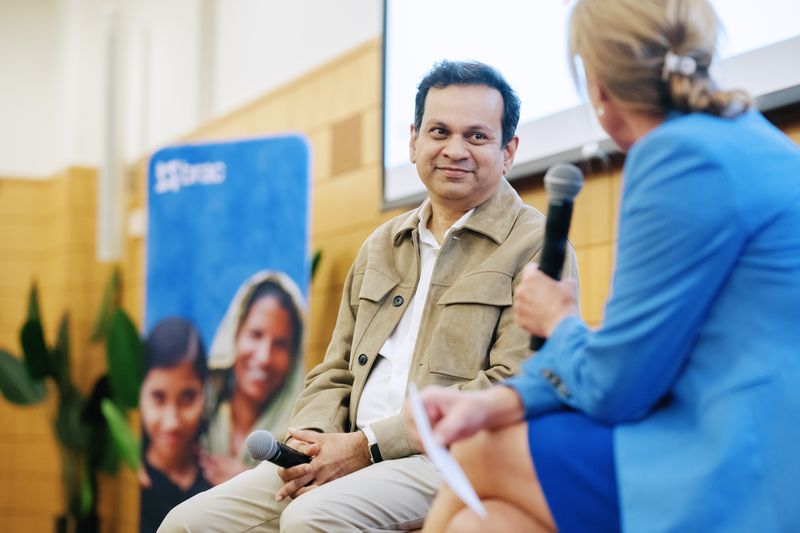
Governments as the ultimate outcome funders
Kate Casey: You also work with governments to scale things up. How should domestic governments set their own agenda that all these actors fit into? How do we think about the balance of power, especially with governments that may not be the highest performing?
Asif Saleh: Governments across the world are proving to not be performing well. Citizens are more aware, and they are seeing what is possible. In the past, they could not see what they were missing out on, but now they can see what is happening with young people across the region. People are a lot less patient.
So governments have a choice: they either need to significantly reform how they do business, or they need to be a facilitator, bring in organizations and philanthropists and delivery organizations who actually can do the delivery of products and services efficiently and quickly. One of the reasons why microfinance does so well? It’s a very simple thing. It’s how fast the loan processing happens - within 48 hours of an application, you get a loan. That’s why, in spite of banks coming in with reduced interest rates, you still see demand. Government systems are still very arcane in terms of ensuring certain processes are followed. They are nowhere to be found in terms of innovating, whether it’s on products, services, or delivery mechanisms that are efficient.
Look at the model in India. They took on a good, innovative model that had been proven, and they said, “we’re going to implement it… and you guys can support us technically.” I think that is a very good model.
Our Prime Minister said this in Bangladesh. They’re looking at engaging us in a meaningful way where we can be a delivery partner in some areas. The future of development will depend on these types of collaborations. You can look at innovation from the social sector, and then also include the government delivery capability with their support, or use the public resources to mobilize these players for you.
You know, in the 1980s and 90s in Bangladesh, the government’s capability was far less. And they were happy to have the NGOs play a far bigger role than they would in other countries. And this is why Bangladesh has been such a hotbed of social innovation.
In the 1980s, for example, with childhood immunization, the government said, “OK, we’re going to carve up the country in three parts. One part, immunization will be done by the government, one will be done by BRAC, and one by CARE. And within about eight years, immunization went from about 2% to about 88%.
Kate Casey: In a way, you’re describing the government as this trust-based philanthropist who's going to hold people accountable for the results, and now worry about the how.
Between the numbers and the stories
Audience member: We hear a lot about people in the tech world who want to donate for impact and a better world. What is your view of effective altruism?
Asif Saleh: Peter Singer was in Bangladesh last week, and he asked me the same question.
Everything cannot be about the RCT. Everything cannot be quantified. But on the other hand, you just have these anecdotal, beautiful stories and you’re basically asking for more money. These are two extremes, and we need something in the middle. The balance is very important. Where you do an RCT is important. They’re funding a generous part of our graduation work in Bangladesh, but they’ve also given a substantial amount to BRAC for the research.
Evidence is important. But not everything in international development should be driven by numbers and RCTs.
One shock away
Audience member: Absolute poverty is shrinking. Is the challenge shifting away from eradicating extreme poverty? What does that mean for the development field?
Asif Saleh: The nature of poverty is changing. Poverty is becoming more urbanized. Poverty is becoming more fragmented. There isn’t absolute poverty, more a poverty for lack of social protection. For those who have fallen through the net, or fallen back into poverty, don’t need the same big push as a two-year Graduation program. They need a shorter intervention, maybe six months or a single financial product, to get back up to speed.
We started seeing these “new poor” during COVID. We’re testing some of these models for them, and researching how impactful they are. So understanding whether Graduation, which predominantly works mostly in rural areas, can work in cities. So we’re researching that model, which is going to be an important part for advocacy and new funders who are looking for evidence.
In Bangladesh, about 40% of people are hovering above the poverty line. They are one shock away. One health shock. One climate shock. With high inflation over the last few years, that number has started to rise again. That does not give a feeling of prosperity. That’s the changing nature of poverty.
So we’re looking at social protection in a different way for resource-constrained countries like ours. For example, we’re really focusing on microinsurance as a way to mitigate some of these risks, built on our microfinance network. We now have almost 2 million members with insurance that protects their crops. It’s not a fundraising initiative, it’s self-sustained.