A young woman with a needle, thread, and a dream of a better life
Parul grew up watching hardship shape the people around her.
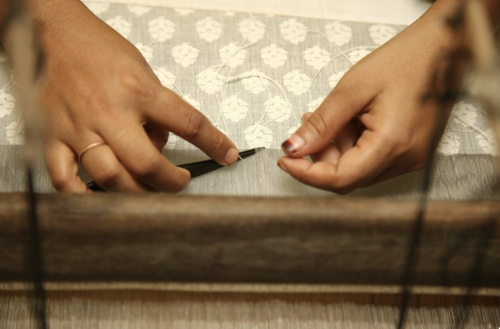
At the Shatkura sub-center, a small workshop that produces artisan goods for Aarong, she learned to work with needle and thread, and she was good at it.
Her detailed stitch work, dedication, and natural leadership set her apart, and she was eventually entrusted to run the sub-center herself.
Parul envisioned something bigger: a future where women in her village could be independent, contribute to their families, and never have to pull a child out of school because of money. So she started teaching, one woman at a time, passing on the stitch work and techniques she’d spent years mastering.
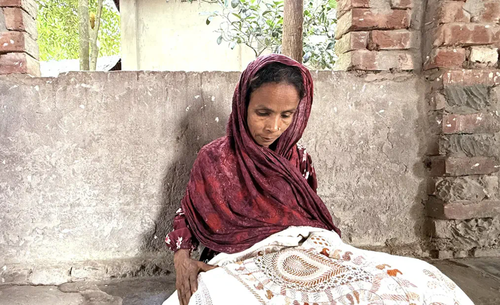
The income was appealing, but the independence and dignity that came with it was more important. Slowly, more women gathered around her. What they found was more than a livelihood. It was a sense of purpose.
Today, Parul has two sons, a husband, and a home with a roof that doesn’t leak. Her sub-center is one of more than 800 like it scattered across Bangladesh, each one small, women-run, and slowly changing how rural economies work.
Bringing the workplace to the women
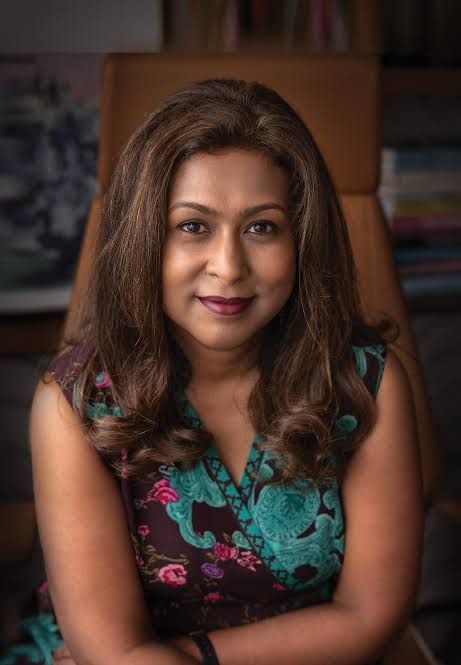
To understand why the model works, it helps to hear from the people who built it. Tamara Hasan Abed, Managing Director of BRAC Enterprises, recently sat down with BRAC USA President and CEO Julia Roberts to explain the thinking behind BRAC social enterprises such as Aarong.
"What essentially we do is the same kind of work we do with our development programs, through social enterprises, but to address the same problem of poverty alleviation and empowerment of the poor," Tamara explains. "We identify a social problem that we feel we can solve through market-based methods, and then we pilot test, and then we go for scaling."
A development program winds down when the grant ends. A social enterprise doesn’t.
"One can carry over one’s lifetime the livelihoods that you create, because it’s an ongoing concern," Tamara says. Getting there takes what she calls patient capital: funding willing to forgo quick returns so that a model has time to prove itself before it can compete like any other commercial business.
For Aarong, patient capital funded a simple idea: instead of asking rural women to come to the workplace, bring the workplace to them.
When Aarong’s original production units drew women from remote villages, many started missing work or leaving altogether. It wasn't for lack of skill or dedication, but because the commute and cultural expectations made it too hard to sustain.
So in response, Aarong redesigned the model. It set up small, decentralized sub-centers under its Ayesha Abed Foundation (AAF), directly in village courtyards, where training is provided onsite, and women do early-stage craft work like embroidery and beadwork without long commutes.
The results speak for themselves. Workforce participation rose. Household income grew, often the difference between a child staying in school or dropping out. And because the work stayed local, so did the money, circulating through village economies.
What it looks like up close
Tamara shared a story that captures what this looks like over time: a woman who had been married off at twelve, and later abused and abandoned by her husband while pregnant, eventually found her way to a production center, and commuted fourteen miles each way to raise her son alone.
But when Tamara saw her recently, everything had changed. Her son is now a veterinarian who drives her to work on his own motorbike. She owns her own land: sixteen decimals of it.
"There are countless stories like this, of people changing around their lives, and being able to actually become the owner of assets and a determinant of their own lives and futures," said Tamara.
Halada knows that from firsthand experience. Married young, she believed she and her husband were building a future together, until he chose to marry again.
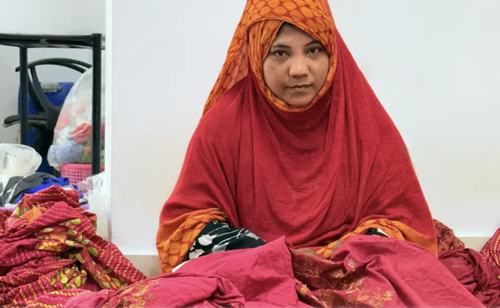
She left and went to Dubai looking for work, but came home with no savings, and had a daughter to support. She found AAF’s Turpai section in Ukhia and quickly proved her efficiency, earning a steady income even while repaying, alone, a debt her husband had left behind.
Six years later, she’s built a life for herself and her daughter that depends on no one else.
There are countless stories like this, of people changing around their lives, and being able to actually become the owner of assets and a determinant of their own lives and futures.”
Tamara Hasan Abed
Managing Director of BRAC Enterprises
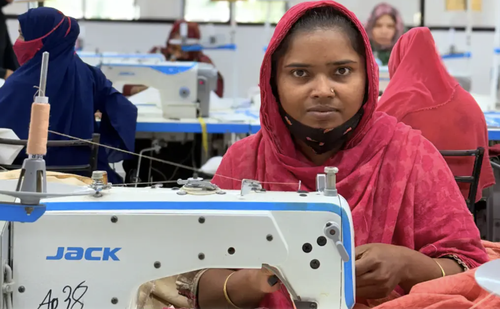
Senoara’s path started in a garment factory in Chittagong, working long hours for low pay as a young girl. She married hoping for stability, but her husband had no steady income, and soon the financial weight of three children fell on her alone.
She moved back to her mother’s house in Ukhia, and found the tailoring section of AAF. This work, six years later, has become the foundation of her family’s life.
She said, with tears of joy in her eyes, “I could not study when I was young. I could have been in a better place if I could. Hence, I don’t want my daughters to face the same struggles I did.”
Today, her daughters are in school. Her husband visits occasionally, but he doesn’t contribute financially, and she’s stopped waiting for him to. She's financially independent all on her own.
I could not study when I was young. I could have been in a better place if I could. Hence, I don’t want my daughters to face the same struggles I did.”
Senoara
Tailoring section, AAF Ukhia
Rewriting the rules
For 22 years, Fatema has worked at the AAF’s Manikganj sub-center, learning the wooden craft called “slet”—work that, in Bangladesh, is almost entirely done by men.
She took the opportunity anyway, trained in Dhaka, and found genuine passion in shaping wood into craft.
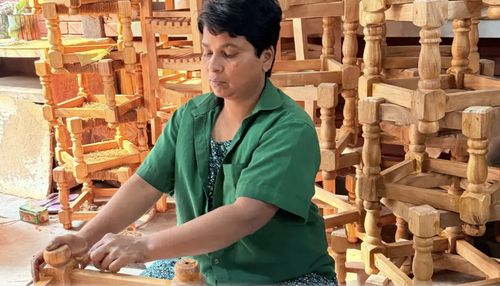
Fatema never married, having watched her sister endure years of mistreatment in her own marriage. Now in her 40s, she keeps an eye on the women around her, and if something seems wrong, she takes action, ensuring no woman is mistreated.
She still faces criticism for working in a “men’s trade,” and even for doing things as simple as riding a bicycle. But instead of letting the comments slow her down, she’s turned them into fuel.
Two decades of honing her craft at the Manikganj sub-center have made her both a skilled artisan and a quiet protector for the women around her.
The thread that connects them
Parul, Halada, Senoara, and Fatema have found more than income through their work as artisans. They have found independence, dignity, and a way to make sure their children won't inherit the same struggles they did.
As Tamara puts it, this is a model where social and economic good aren’t separate. One woman’s pathway out of systemic poverty is, eventually, another woman's chance to do the same.
The solution is a sub-center in a village courtyard. It’s a woman teaching her neighbor how to sew. It’s a daughter in school who wouldn’t have been otherwise. And it’s happening, one stitch at a time, in hundreds of villages across Bangladesh.
Building enterprises that outlast a grant cycle
For more than 40 years, Aarong has proven that lifting women out of poverty and building a sustainable business can be the same goal. Today, the model runs through more than 800 sub-centers across Bangladesh, giving rural women a way to earn, lead, and build independence without leaving their communities behind.