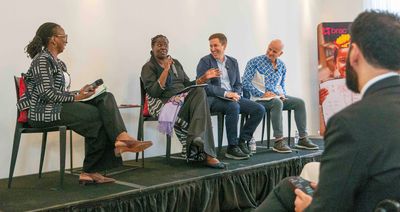
Our “Collaborative Action: Scaling Proven Development Solutions” event on September 24, 2026, wasn’t about pitching new ideas. It was about asking a difficult question: Why don’t we fund the solutions we already know work, at the scale the world actually needs? What will it take to change that?
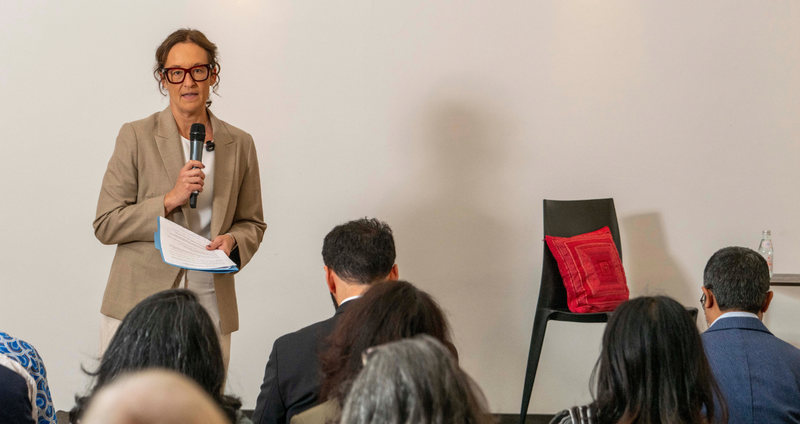
Julia Roberts, President and CEO of BRAC USA, opened the evening with a message about the path forward. “There is a lot of incredible work that can be supported to move the needle,” she said. “We have the evidence to show what works, and collectively, we have an ecosystem of solutions that are proven to deliver impact at scale.”
Anne Mutta, Regional Director for Africa at BRAC International, framed the challenge we’re up against and what’s at stake: We’ve spent years talking about what works in development. We have the evidence and know the proven solutions. Yet the gap between what we know and what we fund, and what we scale, remains stubbornly wide.
The world cannot afford this gap. The 62 million young women across Africa who are shut out of school, work, and training cannot afford it. Neither can the 15 million women-led households in India enduring extreme poverty.
The crises we are facing—extreme poverty, climate change, the rollback of hard-won gains for women and girls—demand more than incremental steps. The moment calls for urgency, bold action, and a willingness to take risks when the evidence backs it up.
The rest of the conversation focused on how to get there, together. Here are some reflections.
The development sector is ready to move forward again
The international development sector has been under immense strain. Eighteen months ago, U.S. government funding for foreign aid was slashed. Budgets were tightened. The cuts were destructive and, in too many cases, deadly. Trust between funders and communities broke.
But now, the industry is shifting.
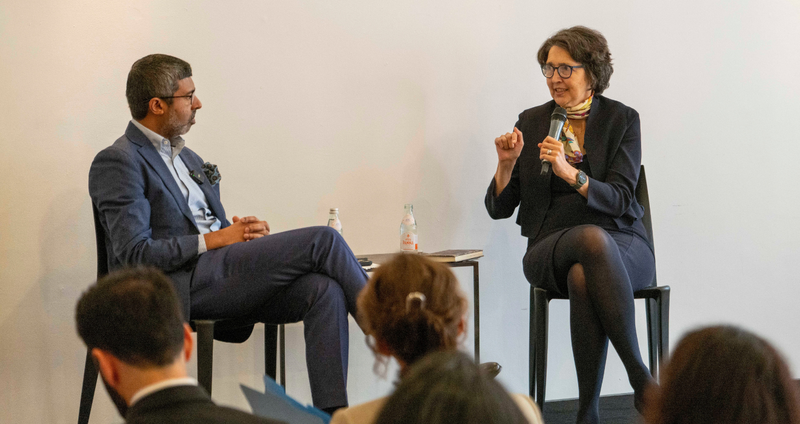
“It seems like parts of the sector are starting to tentatively move forward again, which is great,” said Shameran Abed, Executive Director of BRAC International. “If you're an optimist, we've got to keep talking about real people and real issues and real programs that have a transformative impact on the lives of people across the Global South.”
That optimism is grounded in decades of evidence about what really works when it comes to unmaking poverty. “What’s giving me hope is watching certain organizations take what they've learned from one context to another,” said Rachel Glennerster, President of the Center for Global Development. “BRAC is a great example of that.”
Proven solutions already exist. Our collective job now is deciding to fund them.
The question this moment is asking us is: Are we willing to do development differently?
We need to stop reinventing the wheel
One theme came up again and again, from nearly every speaker: the development sector spends too much time and money reinventing solutions when so many already work. Instead, we need to take those existing solutions to scale.
“Stop doing very projectized, very fragmented sorts of things,” Shameran said. “Work with trusted partners to meet needs at scale.”
Rachel made the same case. “When you try to do so many different things with a set amount of money, the cost-effective program is quite small, and you only cover, say, one district. But if you'd taken all the money in that program and just done that cost-effective approach, you could have done it in the whole country.”
She pushed back on programs that reinvent solutions from scratch rather than building on what’s already been proven. “Too many programs go in with a relatively small amount of money and reinvent the wheel every single time,” she said. “But no—take something that we already know works.”
Rachel and Dean made this case in their recent co-authored piece, “Radical Simplification.” Read the article to further explore why aid works best when it focuses on bringing just a few proven, cost-effective interventions to scale—instead of piling on complexity in only a few places.
Shameran agreed that the evidence is already out there, if funders are willing to look for it. “There's so much in development that we know works at scale, and has transformative impact,” he said. “If you're looking for ideas and evidence, there's plenty out there.”
BRAC itself has more than 50 years of experience working with 145 million people across a dozen countries. The evidence is there.
Both speakers pointed out that taking a proven model to a new place doesn’t mean copying it exactly. It means keeping the underlying principles and adjusting the rest at a surface level to fit the local context. “It’s got to be local, but we shouldn’t be afraid of learning from each other,” Rachel said.
What funders should really be looking for
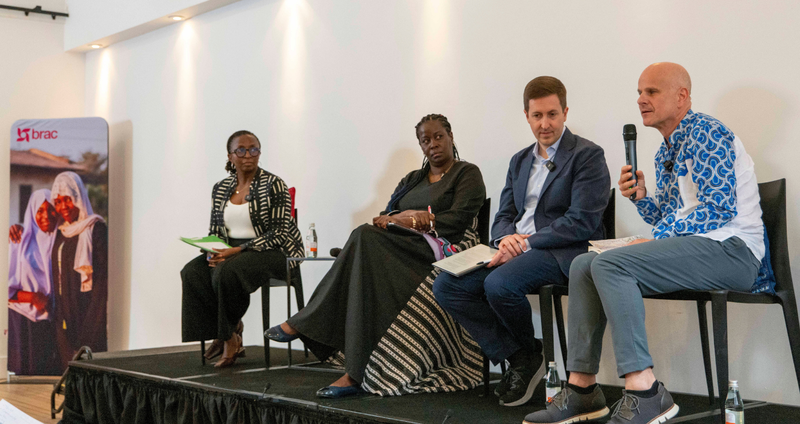
During the panel discussion, Abe Grindle, a Director on Co-Impact’s Programs team, offered a three-part framework for what funders should be looking for: transformative impact, scale, and durability.
“One is the impact: in a person's life, that you're having a significant, meaningful effect, an improvement that's concrete,” Abe explained. “The second is the scale or the reach of what you're doing. The third component is how durable the change is in a person's life.”
Abe continued, “Even more important is the capacity of government to work in a more impactful way for their populations. How durable are the changes and the improvements you're making in that government system?”
“Trying to solve that is profoundly powerful. Whether you're successful because you're unlocking ten, 50, 100x of government resources that ideally can benefit generations of children to come, families to come, not just the ones that fit in your three-year window.”
Abe also pushed funders to think differently about risk. He noted that in finance, Wall Street investors don’t shrink away from what others have already invested in. Rather, they see it as an encouraging sign when other serious investors have already backed something.
But in philanthropy, it tends to work in the opposite way: funders shy away from something because someone else is already funding it. “How can we, as a funding community, actually step up and fund this work the way it deserves, and the way it needs?” he asked.
Abe closed with optimism. “We're at a unique moment,” he said. “Over the last five to ten years in the sector, there have been huge strides in terms of creating incredible opportunity and proof points for us to actually solve some of these enormous problems that we face—if, again, we find the right things and we fund them the way they need to be funded.”
Trust in people closest to the problem
Rosemary Nduhiu, Executive Director of Country Programs at the Mastercard Foundation, brought the conversation back to the core: None of this works without trust in the people closest to the problem. They are the experts in the challenges their community faces. They know which solutions are likely to work best.
“Localization really starts with listening,” she said. “If you are willing to sit in a community and listen to the community, bring them along in trying to solve the issues, then you are truly building trust within that community.”
Speaking about the Mastercard Foundation’s investment in Accelerating Impact for Young Women (AIM) in partnership with BRAC, Rosemary explained what “big bets” look like in practice. “A big bet is having a little faith and a lot of trust in some of the communities that you can empower—and they can be a part of trying to solve for the deep issues and the challenges," she said.
Rosemary continued, “We know that without empowering young people—getting them when they're younger, providing them not just skills, but voice and agency to determine for themselves the outcomes of their own lives—that is the only way you can get to scale.”
Dean Karlan, Founder of Innovations for Poverty Action and Professor of Economics and Finance at Northwestern University, has seen this kind of trust in action for years. Reflecting on a visit to BRAC’s Graduation program in Bangladesh 15 years ago, he said what struck him most was “the openness and the commitment that BRAC had, not just to their own programs, but to sharing what they're learning in a very open and transparent way.” He reflected, “Not everybody does that. And they did it before they knew the results.”
Make it big. Make it bold. Make it scary.
If there was one call to action from the evening, it was this: funders need to be bolder. “Make it big, make it bold, make it scary,” Rosemary said.
She went further, urging funders to move even when the outcome isn't guaranteed. “Start with that bold idea, be the first person who makes that first step, and be comfortable that you might get it right sometimes but there's a possibility you won't. But it's okay.”
Rosemary continued, “People will try, and it's okay if five, six, eight, ten of us are trying. Because the scale of the issue is so significant—it's not just a problem for one funder. Let's get as many of us trying to solve this challenge in the same room with these people.”
Dean offered a practical way to think about this shift when working with funders: “It's about meeting them where they are,” he said, with a “nudge to do a little bit more.”
Shameran connected this directly back to BRAC's own work. “We need the big funders to come and help us scale these programs,” he said. He described talking to larger donors not project by project, but about “the principles that we've learned over the last 50 years trying to do development at scale, with quality and with impact.”
He also stressed the need for honesty about results: “Double down on the things that work, wind down the things that don't, and move on.”
Doing development differently, together
No one left this conversation with all the answers. But there was a shared understanding of what's holding the development sector back and an agreement on what it will take to move forward.
The solutions exist. The evidence exists. What's missing is the collective will to fund proven models at the scale the moment demands and the courage to do it together. This is our opportunity to close the gap.
Doing development differently means trusting the people and organizations closest to deep-rooted challenges to lead and being willing to back them boldly. When that happens, real, lasting progress is possible.
Thank you to everyone who joined us in the room and to everyone continuing this conversation beyond UN Week 2026.