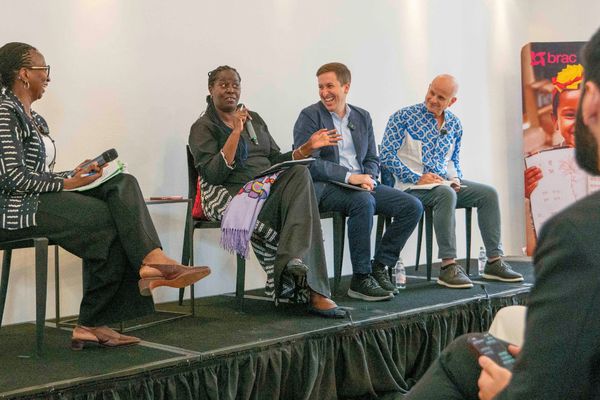
On June 23, BRAC USA hosted its signature Meeting the Moment event in Chicago, bringing together philanthropic leaders, wealth advisors, and global development practitioners to examine how collaborative funding and bold philanthropy can rise to meet this historic moment in international development. The event featured a fireside chat between Julia Roberts, President & CEO of BRAC USA, and Jenna Schornack, Vice President of Programs and Social Impact at Lever for Change, followed by a panel discussion moderated by Julia and featuring Sheila Cawley of the Chicago Community Trust, Chris Clarkson of AllianceBernstein, and Julie Kedroske of Innovations for Poverty Action (IPA).
Filling the gap: the case for collective funding
Julia opened the fireside chat by naming what many in the room already knew: the architecture of global development is shifting at an unprecedented rate.
For decades, philanthropy and individual donors piloted innovations, tested theories, and iterated, then looked to bilateral development assistance to help scale what worked. With that funding now significantly diminished she said, “There’s probably no single philanthropist or donor that can fill that gap. But the opportunity really lies in collective funding.”
Meeting the Moment Chicago: fireside chat
The opportunity really lies in collective funding.”
Julia Roberts
BRAC USA
She pointed to BRAC’s own expertise as proof. More than 20 years ago, BRAC helped design a national-level strategy in Bangladesh by setting the evaluation framework and accountability structures first, then inviting governments to fund it, giving them the flexibility to move funding as conditions changed. The Canadian and Australian governments joined, and the model has continued in successful cycles. BRAC is now asking: how can that same logic apply to philanthropy?
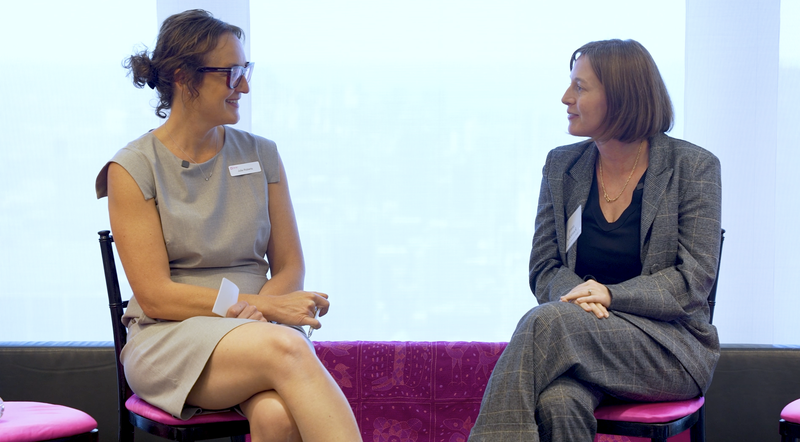
Jenna Schornack offered a view from the other side of the table. Funders, she said, have split into two camps in what has been a “tough” past year. Some are operating with an abundance of caution, waiting to see what is happening, what organizations are still standing at the end of this year, what strategies will emerge, and some funders don’t want to take responsibility for the work that was typically happening under USAID or other government funding. Others, she noted, who tend to be women, were already acting boldly and collaboratively before these changes, and are now doubling down. Lever for Change recently ran a challenge with Melinda Gates, who committed $250 million towards women’s and girls’ health, alongside an initiative with Enlight Foundation and The Patchwork Collective, who have committed $25 million to climate change, as collaborative, flexible grants. “They’re saying: you tell us what you need, and we will fund it. And we’re really excited about the role women are playing in philanthropy.”
Safety in numbers and the rise of quiet giving
Julia pressed on a dynamic she has been hearing from foundations: the appeal of collaborative funds lies partially in shared accountability. If a pooled investment doesn’t achieve everything it set out to, no single funder is left with the risk alone.
It’s expensive to work together...but in the end they’ll be more impactful.”
Jenna Schornack
Lever For Change
Jenna confirmed that there is a lot of quiet giving. Donors are using donor-advised funds more frequently, shying away from certain topics, and choosing vehicles (like Lever for Change, Audacious Project, and Co Impact) that provide not just infrastructure, but a kind of cover for bold moves. “It’s a good time to be a funder in terms of there’s a lot of services available in different intermediaries and institutions,” Jenna said, “but there’s also just the cover in terms of collaboration and vetting and PR, and all the things that donors might worry about when they are going out and making a gift they feel sort of uneasy about.”
Durable, flexible capital
The conversation turned to what Jenna called "durable capital," a term for flexible, multi-year funding that allows organizations to build the infrastructure they need to get to the next level. Not quite startup funding, and not scale funding, something in between: a Series B of the nonprofit world.
She offered the Louisiana Public Health Institute as an example. The organization works at the intersection of climate and health, specifically, how to keep health clinics online when hurricanes knock out power. Louisiana Public Health Institute needed time, partners, and money to bring scientists, doctors, community organizers, and public health officials together around that shared challenge. Jenna noted, “It’s expensive to work together, and so they need time and space and money to make that happen. But in the end they’ll be more impactful.”
Julia noted BRAC has benefited from durable capital multiple times, particularly early in the development of enterprises, creating markets and livelihoods at scale. BRAC’s flagship lifestyle brand, Aarong, began in 1978, and today collaborates with 87,000 artisans across Bangladesh, providing fair terms of trade. She also raised the related question of impact investing (which is less flexible and more determined on the market-rate) and whether donors drawn to that model can be guided toward approaches that preserve more room to maneuver. Jenna’s answer was practical: "There are many different tools in the toolbox. We encourage donors to try different things, and see what they’re comfortable with. Not every tool is going to be the right match for the investment they want to make, but organizations like BRAC have given really good examples of diversified revenue streams and different types of investment that can be really impactful. There are amazing organizations…that are ready for large, flexible investments."
Philanthropy at the local level: The Chicago Community Trust
During the Speaker Panel, Sheila Cawley brought the perspective of one of the country’s oldest and largest community foundations: the Chicago Community Trust, approaching its 110th year and nearly $7 billion in assets.
One of the biggest obstacles to mobilizing individual donors, she said, has been language. Terms like “ecosystem” can feel abstract. “Over the past year we were really pushed to get sharper on [language] and to start meeting our individual donors where they were and help them understand.”
That insight led to a change in strategy: rather than asking individuals to contribute alongside institutional funders making $5 million gifts (where a $10,000 donation can feel invisible) the Trust is launching the We are Chicago Fund, a vehicle designed specifically for individual donors that gives them a sense of belonging and meaningful participation. “We’re really working on that sense of belonging,” Sheila said, “working on language that makes sense to them, and giving them vehicles that are right-sized for them.”
She also described the Resilient Chicago Fund, created in response to the loss of federal funding. The basic framework, she explained, stems from listening to community partners and leaders. “We can't come in and say this is going to fix whatever issue it is,” Sheila said, “So we listen very hard to them. We have a long history of collaboration and partnership and trust. The fund, which set out to incentivize systems change and help nonprofits innovate quickly by getting them the research they needed and forcing them to ask questions: How do we collaborate? Do we share accounting offices? How do we think about the workforce differently? The first round drew 240 applications.
Meeting the Moment Chicago: panel discussion
Making the financial case for giving now
Chris Clarkson of AllianceBernstein brought a data-driven lens to the question of urgency. Many foundations, he noted, wrestle with the same fundamental tension: spend now for immediate impact, or preserve the endowment to sustain giving over decades?
“If now is when that money is needed, you can really step up."”
Chris Clarkson
AllianceBernstein
His answers, backed by analysis he co-authored with Geneva Global: in most scenarios, foundations can give significantly more today without materially reducing their long-term cumulative impact. A $10 million foundation giving an extra $1 million in year one – an extra 10% of their value — would give roughly the same cumulative total over 30 years as one that held back, while still seeing its assets grow by about a third over that period. “If now is when that money is needed, you can really step up,” he said.
Chris also highlighted research conducted with the Lilly Family School of Philanthropy at Indiana University, which analyzed over 800,000 Forms 990s from more than 170,000 nonprofits to identify the metrics that best reflect organizational financial health. One finding particularly resonated in this moment of funding disruption: administration ratios (your administrative expenses as a percentage of your overall operating budget) can be too low. When organizations are under-investing in their own infrastructure, revenue tends to become more volatile and less predictable. “As high as 30 [percent] is not too high,” he said. “I see contracts at seven [percent], seven is not enough to sustain the organization.”
Evidence and the “messy middle” of global development
Julie Kedroske of IPA closed the panel by pulling the conversation toward evidence, and what she called the “messy middle” of global development innovation.
IPA recently scanned the literature to identify 50 promising innovations in the sector, narrowing to 14 that are “emerging” with academic interests and publications, but not yet at government scale. These are innovations that are highly likely to be scalable, but where critical questions remain unanswered: How cost-effective are they? Do they hold across different contexts? What delivery models work? “It’s not the most glamorous thing to fund,” Julie acknowledged, “but it’s like the messy middle of how we figure out what needs to be done to take things to scale.”
When asked what she is optimistic about, she opened up about new long-term follow-up data from a graduation program in Uganda, six years after the program was completed.
We’re seeing indications and evidence of this intergenerational cycle of poverty being interrupted by this really cost-effective, impactful program.”
Julie Kedroske
Innovations for Poverty Action
The data, tracking families with children born into households where a woman completed the graduation program, is showing the first signs of an intergenerational cycle of poverty being interrupted. At the midline, nothing. At six years, movement. “We’re seeing indications and evidence of this intergenerational cycle of poverty being interrupted by this really cost-effective, impactful program,” she said. “And I’m grateful that we had donors and funders willing and able to stick it out and to invest in that kind of long-term evidence.”
A shared sense of what’s possible
The speakers all shared undertones of a similar message: the current moment is hard, but it’s teaching us. The loss of development funding is revealing which forms of collaboration are durable, which strategies are backed with enough evidence to defend, and which funders are truly in it.
In a world in which we have 700 million people living below the poverty line, every dollar does matter.”
Julia Roberts
BRAC USA
Julia closed with a reflection on scale and individual giving. A $500 donation to BRAC, she noted, can fund a family of five to go through the poverty graduation program for two years. "An organization’s size doesn’t mean they can’t do equal good with any level of funding. And in a world in which we have 700 million people living below the poverty line, every dollar does matter."
The Meeting the Moment series continues to bring together leaders across philanthropy, finance, and global development to explore what it means to act boldly in a changing world. Some responses were edited for length and clarity.
Kendall Kozlowski is Communications Intern at BRAC USA.