The following excerpt is from a piece that originally appeared in The Business Standard. Read the full piece.
In the coastal expanses within the climate-vulnerable regions such as Patuakhali, Barguna, Bagerhat and Satkhira, croplands have become a battleground for human survival.
Here, during the critical Rabi dry season, a cruel irony has long defined the lives of smallholder and marginal farmers.Their fields are lush with the promise of harvest, yet the lack of water repeatedly shatters these agrarian dreams..
It is a recurring nightmare where crops wither midway into their growth cycles, promising seeds rot into husks, and vast tracts of fertile land are left completely barren.
For decades, the lifeblood of this coastal agriculture was tied to the mechanical rattle of the diesel-powered water pump. For the vulnerable farmers of BRAC's Nilganj Adaptation Clinic, this dependence felt like a slow economic execution.
...
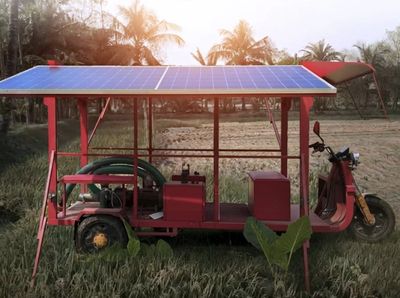
In response to this crisis, BRAC's Climate Change Programme introduced a groundbreaking solution: a transportable, mobile solar-powered irrigation system nicknamed 'Ponkhiraj' or the mythical flying horse from your grandmother's tales.
This specialised solar van is designed to drive right up to the edges of a farmer's plot, drawing water directly from local canals and ponds.
Operating entirely on solar energy, the self-propelled van eliminates diesel and electricity costs entirely while producing zero carbon emissions. The machine is equipped with onboard storage batteries, allowing it to function as a mobile power hub. It can even serve as a local transport vehicle or supply domestic electricity to nearby households.
In a single six-hour day of operation, this mobile unit can pump up to 60,000 litres of water per hour, successfully irrigating two to two and a half acres of land.
The economic relief for the coastal farmers was immediate and life changing.
...
Traditionally, irrigating a single bigha of land using conventional fuel systems cost between Tk2,500 and Tk4,000 depending on the crop.
With the introduction of the mobile solar van, that cost plummeted by nearly 70%, dropping to a mere Tk500 to Tk600 per bigha.
Where a farmer previously spent over Tk1,000 on diesel and equipment rentals for six hours of irrigation, the mobile solar system provided the exact same volume of water for just Tk100.
...
With an uninterrupted flow of water secured, the sunflowers achieved healthy growth, significantly reducing production risks and replacing community despair with a newfound financial confidence.